
On the Sensex chart, NTPC, SBI, UltraTech Cement, ICICI Bank, Tata Steel, Bajaj Finserv and Bjaja Finance were among the major laggards, shedding as much as 1.63 per cent.

Benchmark indices failed to hold on to early gains and closed in the red for the seventh straight session on Thursday, with participants remaining in wait-and-watch mode ahead of the RBI's interest rate decision. Unabated selling by foreign funds added to the pressure, though a modest recovery in the rupee cushioned the fall, traders said. After rallying in early trade, the 30-share BSE Sensex came under selling pressure in the afternoon session and closed 188.32 points or 0.33 per cent lower at 56,409.96.

The third-quarter financials didn't excite market watchers. But equity investors can still make money if they invest in the right stocks.

Disgruntled executives are already pinning hopes on the new banks, too.

India's industrial production growth remained subdued for the second straight month and expanded by 3.2 per cent in October, mainly due to the waning low base effect while mining, power and manufacturing sectors performed well. The manufacturing sector, which constitutes 77.63 per cent of the Index of Industrial Production (IIP), grew two per cent in October, according to data released by the National Statistical Office (NSO) on Friday. The mining sector output rose 11.4 per cent in October, while power generation increased 3.1 per cent.

India's manufacturing sector activities improved in September as companies benefited from strengthening demand conditions amid the easing of COVID-19 restrictions, a monthly survey said on Friday. The seasonally adjusted IHS Markit India Manufacturing Purchasing Managers' Index (PMI) improved from 52.3 in August to 53.7 in September, indicating a stronger expansion in overall business conditions across the sector. The September PMI data pointed to an improvement in overall operating conditions for the third straight month. In PMI parlance, a print above 50 means expansion while a score below 50 denotes contraction.

Domestic ratings agency Icra on Monday forecast a 2 per cent GDP growth in the fourth quarter of 2020-21, and a 7.3 per cent contraction for the full fiscal year. From a GVA or gross value added perspective, the agency pegs Q4 growth at 3 per cent and the full year contraction at 6.3 per cent. According to the agency, the 2 per cent projected GDP growth will help the economy avoid a double-dip recession as indicated by the National Statistical Office (NSO) for Q4. Icra's projection is better than the 8 per cent contraction forecast by the NSO as it sees Q4 growth at only 1.1 per cent.

ITC was the top loser in the Sensex pack, tumbling over 5 per cent, followed by ICICI Bank, Kotak Bank, Axis Bank, SBI and HDFC Bank. NSE Nifty sinks 354 points to 17,857.25.

BSE benchmark Sensex nursed losses on Friday as investors pocketed gains after a five-session winning streak amid a bearish trend overseas. A depreciating rupee and foreign fund outflows further soured risk sentiment, traders said. The 30-share gauge, which had started the trade on a firm note, soon gave up all the gains and finally ended 651.85 points or 1.08 per cent lower at 59,646.15. The broader NSE Nifty snapped its eight-day rally to close at 17,758.45, down 198.05 points or 1.10 per cent.

Workers allege an official dumped the National Flag, hoisted inside the factory, in a dustbin after tearing it.

The percentage was 63.14 per cent in Hathras, 61.89 per cent in Firozabad, 63.04 per cent in Kasganj, 65.7 per cent in Etah, 61.51 per cent in Mainpuri, 59.13 per cent in Farrukhabad, 61.93 per cent in Kannauj and 58.35 per cent in Etawah.

Indian companies are planning to increase investments in the new year to expand capacity, acquire companies, and go on a hiring spree, a survey of top executives showed. They, however, cited rising costs, weak consumer demand, and increasing interest rates as major concerns for 2023 which may impact their plans.
ITC has been one of the best performing large-cap stock at the bourses thus far in calendar year 2022 (CY22), rallying nearly 52 per cent during this period and outperforming the sector benchmark - the S&P BSE FMCG index - by a wide margin that moved up around 17 per cent during this period. However, the counter has lost over 5 per cent from its recent high of Rs 346.25 hit on September 23, 2022 and has underperformed the S&P BSE Sensex, which has lost nearly 2 per cent since then. So, is the rally in the stock coming to an end, and is this a good time to book profit?


The stellar rise in corporate earnings in financial year 2021-22 (FY21) and FY22 did not result in a corresponding boom in capital expenditure (capex), with listed companies' investment in fixed assets rising just 2.3 per cent year-on-year (YoY) in FY22, growing at the slowest pace in the last six years. In comparison, the firms' combined net profit jumped 63.5 per cent YoY in FY22, while net sales increased 31.1 per cent - the fastest pace in over a decade. The 955 non-financial companies in Business Standard's sample reported combined net profit of Rs 7.18 trillion in FY22, compared with Rs 4.39 trillion in FY21 and Rs 2.59 trillion in FY20.

Equity indices made an emphatic comeback on Friday after falling for seven straight sessions after the RBI hiked interest rates by 50 basis points on expected lines and projected inflation coming under control from January next year. A strong recovery in the rupee added to the momentum, traders said. Overcoming a wobbly start, the 30-share BSE Sensex soared 1,016.96 points or 1.80 per cent to settle at 57,426.92. During the day, it rallied 1,312.67 points or 2.32 per cent to 57,722.63.

House economists at the nation's largest lender State Bank of India (SBI) have urged the government to budget for nursing the pandemic-ravaged economy and not to focus too much on fiscal consolidation as there is a need for more stabilisation measures to sustain the fledgling recovery. And one of the best way to begin the new fiscal is to complete the share sale of LIC this fiscal. This can go a long way in repairing the overstretched balance sheet which in turn will bring down fiscal deficit to a much lower 6.3 per cent in FY23 as the public coffers will be left with a cash surplus of at least Rs 3 lakh crore to begin the new fiscal, SBI chief economist Soumya Kanti Ghosh said in a pre-Budget note on Wednesday.

The temptation to get into businesses that are hot is perhaps too great for any politician, no matter what his public slogans are. Nehru plunged into hot sectors of his time -- engineering and iron and steel. Modi has plunged into digital payments -- the hot sector of his time, notes Debashis Basu.

Industrial production growth entered positive territory after a gap of two months with a record 22.4 per cent rise in March this year, mainly due to the low-base effect and good show by manufacturing, mining and power sectors. The manufacturing sector -- which constitutes 77.63 per cent of the index of industrial production (IIP) -- grew by 25.8 per cent in March 2021, as per the data released by the National Statistical Office (NSO) on Wednesday. The mining sector output too grew 6.1 per cent in March, while power generation increased by 22.5 per cent.

Industrial production surged by 13.6 per cent in June mainly due to a low-base effect and good performance by manufacturing, mining and power sectors but the output remained below the pre-pandemic level. The manufacturing sector, which constitutes 77.63 per cent of the Index of Industrial Production (IIP), grew by 13 per cent in June this year, according to the data released by the National Statistical Office (NSO) on Thursday. The mining sector output rose by 23.1 per cent in June while power generation increased by 8.3 per cent.

India's industrial production growth slowed down for a fourth straight month in December to 0.4 per cent mainly due to a poor performance by the manufacturing sector. The manufacturing sector, which constitutes 77.63 per cent of the Index of Industrial Production (IIP), contracted by 0.1 per cent in December, according to the data released by the National Statistical Office (NSO) on Friday. In December 2021, the mining output rose by 2.6 per cent, and power generation increased by 2.8 per cent.
Titan was the top gainer in the Sensex pack, rising over 3 per cent, followed by M&M, Reliance Industries, Axis Bank, TCS, Maruti and Infosys. NSE Nifty surged 122.10 points to 15,885.15.

Ratan Tata, chairman of Tata Motors said that rising costs of fuel and raw materials are the biggest worry for the automobile industry. Tata also warned of tough times for the company as its market share slid in the last financial year.

The next auction for bauxite blocks in Odisha may see heightened interest with Adani Group charting an entry into alumina refining and existing players looking to boost capacity. Hemant Sharma, principal secretary, Odisha industries department, said that three bauxite blocks have been scheduled for auctions this year. Adani Group - which will be setting up a 4-MMTPA alumina refinery and may enter aluminium production - is expected to bid for mines, though raw material linkages shall be available from Odisha Mining Corporation (OMC).

Benchmark stock indices Sensex and Nifty tumbled nearly 1 per cent on Wednesday due to profit booking in banking, financial and IT stocks after a recent rally. The 30-share BSE Sensex plunged 537.22 points or 0.94 per cent to end at 56,819.39 as 24 of its stocks declined. During the day, it tanked 772.57 points or 1.34 per cent to touch a low of 56,584.04. The broader NSE Nifty declined by 162.40 points or 0.94 per cent to 17,038.40 with 39 of its constituents ending in the red. Bajaj Finance was the biggest loser among Sensex stocks, dropping by 7.24 per cent.

After two years of a record low interest-rate regime, Indian corporate houses are experiencing a sharp and abrupt increase in funding costs. With the Reserve Bank of India last month making an unequivocal turn towards policy tightening amid high inflation, firms looking to tap the capital markets for funds are ending up shelling out more. The yield on the benchmark triple-A-rated corporate bonds maturing in three years has climbed 98 basis points (bps) since the policy rate hike in May. It was last at 7.47 per cent, Bloomberg data showed.

India has agreed to allow import of pork and pork products from the US as a part of a bilateral trade deal which will facilitate export of Indian mangoes and pomegranate to the US. The development comes months after the two governments renewed the India US Trade Policy Forum (TPF), after which both nations agreed to iron out thorny issues that included market access issues pertaining to the agriculture sector.

The government has amended rules of the Foreign Exchange Management Act (FEMA), paving the way for up to 20 per cent foreign direct investment in the insurance behemoth LIC. The government is planning to dilute its stake in LIC through the the Initial Public Offering (IPO). LIC in February had filed the Draft Red Herring Prospectus (DRHP) before the markets regulator Sebi for the IPO.

Driven by a historic IPO boom that saw 63 issuers, led by new-age tech companies, garnering a whopping Rs 1.2 lakh crore ($16.6 billion) from the primary market, investment bankers laughed their way to the bank collecting $1.1 billion in fees in the year just gone by, making it the highest-ever advisory fees collected, says an industry report. At $16.6 billion, the initial public offers (IPO) set a lifetime record in 2021, bettering the previous record of $10.8 billion in 2017 by a wider margin. While the number of IPOs more than doubled from a year ago to 63, the proceeds were more than four-times the amount raised from the same period previous year and the momentum is likely to continue as more IPOs are anticipated next year, with mother of all issues, LIC issue, expected to boost proceeds next year much higher, it said.

A rare bonhomie among three private telecom companies in raising tariffs coming on the back of a bailout package by the government may have helped the telecom sector avert a crisis but the challenges haven't ceased to exist as the industry faces a cash-guzzling task of rolling out 5G networks in the coming months. The sector that provides direct and indirect employment to millions is projected to see Rs 1.3 lakh crore to Rs 2.3 lakh crore of investments in the coming years in creating robust infrastructure and building telecom and network products that have been incentivised by the government through PLI and other initiatives. After years of cut-throat competition and the apex court ruling on payment of past statutory dues left some players in the lurch, billionaire Sunil Mittal's Bharti Airtel and struggling Vodafone Idea almost in tandem raised tariffs, taking the plunge they had long been talking about.

Finance Minister Nirmala Sitharaman is likely to strike a fine balance between being fiscally prudent and growth supportive when she presents her fourth straight budget on Tuesday, which is expected to have plans to boost spending to revive investment and create jobs. The Budget for the fiscal year starting April 1, 2022 is likely to raise spending on infrastructure to set the economy on a firmer footing. The stage for the Budget presentation was set by the Economic Survey stating that the government has the fiscal space to do more to support the economy that is forecast to grow at a healthy 8-8.5 per cent growth in the 2022-23 fiscal.

The Tata group companies are now more valuable than all the listed central public sector undertakings (CPSUs) or companies in the country. The key 20 listed Tata companies ended the 2021 calendar year with a combined market capitalisation of Rs 23.36 trillion, ahead of the 70 listed CPSUs, which had a combined m-cap of Rs 23.2 trillion. In comparison, these CPSUs had a combined market capitalisation of Rs 16.7 trillion at the end of December 2020 against the Tata group firms' combined m-cap of Rs 15.7 trillion.

Retail inflation inched up to 4.48 per cent in October due to an uptick in food prices, government data showed on Friday. The Consumer Price Index (CPI) based inflation was at 4.35 per cent in September and 7.61 per cent in October 2020.

Steel and petroleum refinery products turned the table by expanding 11.7 per cent and 4.9 per cent respectively in November, 2009.

Talk to any member of the cabin crew on any Indian airline and you will hear the worst horror stories. Almost always, the targets of abuse in the air are female staff members who are called 'servants' or worse, points out Vir Sanghvi.

Industrial production contracted by 1.9 per cent in November, entering the negative territory after a two-month gap, mainly due to poor showing by manufacturing and mining sectors, official data showed on Tuesday. The manufacturing sector -- which constitutes 77.63 per cent of the index of industrial production (IIP) -- recorded a contraction of 1.7 per cent in November 2020, as per data released by the National Statistical Office (NSO). Mining sector output too witnessed a decline, shrinking 7.3 per cent.

Reliance Industries accounted for Rs 6.3 trillion in wealth created since 1995; closest rival was Hindustan Unilever which was at Rs 4.9 trillion.

The country's exports jumped by 60.29 per cent to $34.45 billion in March even as the outbound shipments contracted by 7.26 per cent during the full 2020-21 fiscal to $290.63 billion. Imports too grew by 53.74 per cent to $48.38 billion in March, but dipped by 18 per cent to $389.18 billion during April-March 2020-21, according to the government data released on Thursday. Trade deficit during March 2021 widened to $13.93 billion from $9.98 billion in March 2020.
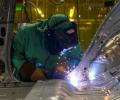
The manufacturing sector, which constitutes 77.63 per cent of the IIP, contracted by 0.4 per cent in March as compared to 5.7 per cent expansion in the year-ago month.

Trade deficit during the month narrowed to USD 14.54 billion from USD 15.3 billion in January 2020. It was USD 15.44 billion in December 2020.
